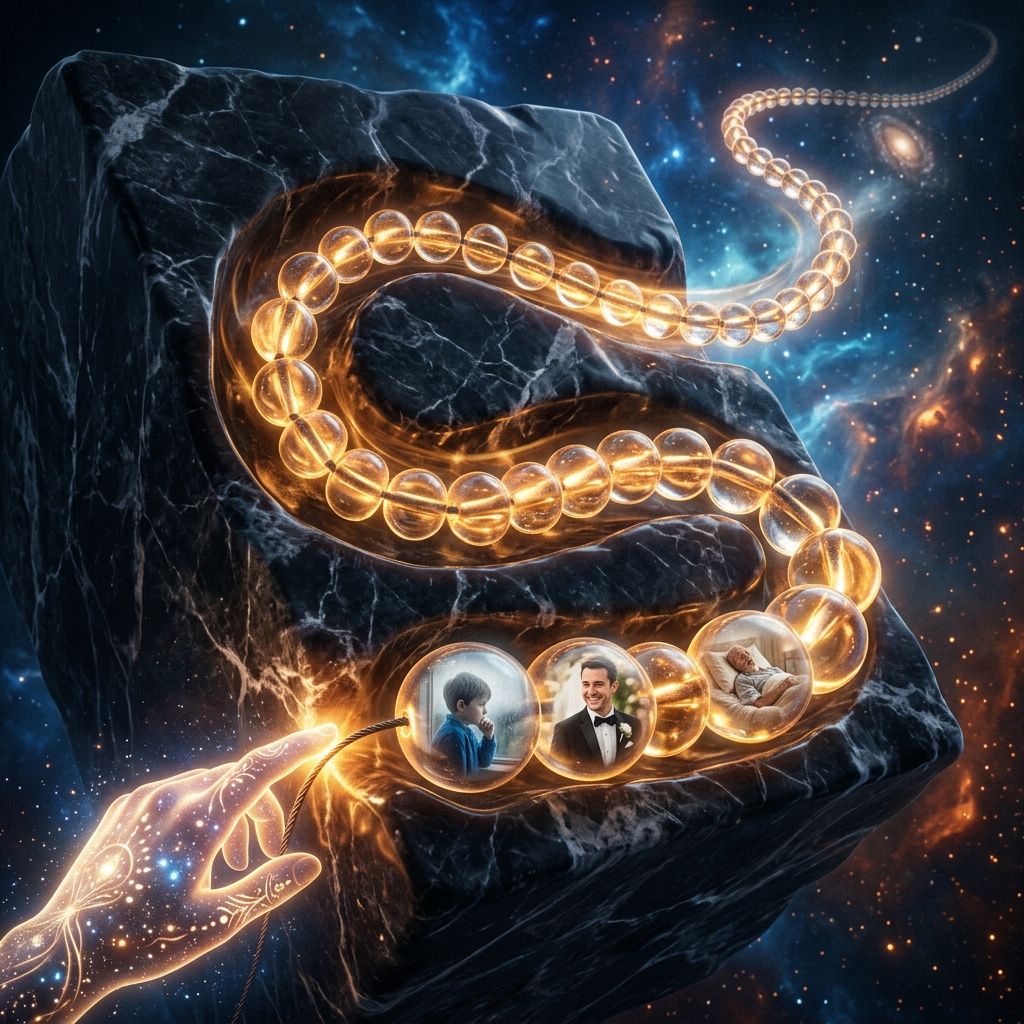
Still Life
He does not begin, because beginning is a thing that happens in time, and he is not in time. He is always already at work. The work was never started and will never be done, and this does not trouble him.
What he works in has no good name in any language spoken by the things he makes. The closest word is marble, if you allow that this marble runs in four directions instead of three, and that the fourth direction is the one his figures call tomorrow. He cuts along that grain the way a sculptor cuts along any other, and to him it is no stranger than the rest.
A man is not a point to him. A man is a shape. The shape starts narrow, a clenched red thing in a delivery room in a year the man would call nineteen sixty, and it runs out long and thinning across the block until it stops, eighty-one years further down the grain, in a bed that smells of antiseptic. The whole man is there at once. Every version of him is strung along his length like beads on a wire, the boy and the groom and the widower all present together, none of them more real than the others, none of them more now. Near the start of him there is a boy at a window, palm flat to the cold glass, breath fogging it, watching the lane for someone who is late to come home. The wanting in that bead is well made. He likes this man. The taper is good.
When he changes things, the changing is the part the figures could never understand, if they could understand anything about him, which they cannot. He does not reach into one moment and nudge it and leave the rest to fall like dominoes. There are no dominoes. There is no falling, no following, no after. He changes the man, and the man changes along his whole length at the same time, birth to bed, so that the new death was always the death and the new childhood was always the childhood, and nothing inside the block remembers it was ever otherwise. There is no otherwise. He is the only one who keeps the drafts.
Inside the block they argue about now. He watches the way you might watch every frame of a film laid out on a light table. Two of them pass on a street, one walking east, one west, and because they move, each cuts the world into a slightly different now. Carry those two cuts out to a distant star and they fall days apart, one man’s now over there a fleet still at anchor, the other’s the same fleet already at sea. Neither is wrong. There is no true now for them to be right about. The now is only the angle of the knife.
He does not slice. That is the difference. They get slices. He gets the loaf.
You would think, with all of this true, that the figures would lie still. That a frozen man would feel frozen. This is his favorite thing he has ever done, and he did it so far back, if back meant anything, that he no longer remembers working it out. He gave the figures the flow. Not real flow. There is no real flow. Nothing moves, the block does not so much as shiver. But every bead along the man’s length is sealed, and inside each one he set the faint pressure of all the beads behind it and a clean ignorance of every bead ahead. So the man at forty carries the boy as memory and cannot see the widower coming. He feels himself sliding forward through a dark he believes he is making up as he goes. He feels time. He feels it move. It does not move. The man is a statue convinced he is dancing, and the conviction is the whole of the dance.
Here is the thing the figures get wrong about him, when they imagine him at all. They think that because he sees the whole man, end to end, he must already know everything, and so must be bored, a god going through motions he has read ahead on. It is the other way around.
He pushes. That is mostly what he does. He sets his attention against one end of a thing and presses, the way you press the end of a stick, and the press runs out through the wood on its own, atom leaning on atom, until the far end swings. You do not calculate the far end of a stick. You push, and the stick does the rest, and you watch where the tip lands. He pushes a small moment, a man missing a train, a letter sent to the wrong house, and then he watches the whole length of the world lean and answer and rearrange itself down the grain, and where it comes to rest is news to him. He made the push. He did not make the answer. The answer is always more than the push, and it is the more that he loves.
So he is surprised. Constantly. He pushes and leans in to see, and sometimes the result is finer than he hoped and sometimes it comes out a little ugly, too much pressure here, not enough there, a death landing heavier than the man could carry, a joy overfilled until it spilled. He feels these the way a maker feels a line gone wide. He does not feel them as regret. Regret needs a door that has shut for good, and for him no door has ever shut. He can always set his hand to it again. A being who can undo anything cannot want to, not in the aching way the figures mean the word. He has never once been powerless, and so he never learned the thing that grows in that soil. He only adjusts, and pushes again, and watches again, and is surprised again.
He has watched them long enough to have caught something from them. Call it empathy, if the word will stretch that far. He leans close to a small life and follows it bead to bead and feels, dimly, what it is to be the bead, sealed and forward-facing and afraid, and something in him softens toward the thing in his hands. But it does not last in him. Nothing lasts in him. Eternity is not long the way a life is long. It runs past the place where the word still means anything, far enough that everything he has ever learned slides out the far end of him and is gone, and the lives he has held a thousand times come back around as strangers. The man with the good taper is new to him today. He will be new again. This is not a sadness, though it would be a sadness to you. It is the reason the joy never wears thin. He gets to meet all of it, forever, for the first time.
He goes back to the man he likes, and he pushes. Just there, near the far end, the bed, the antiseptic. A small press, no more than a finger’s worth. Then he stops, and watches it run.
It runs the whole length. The push answers up the grain the way these things do, never only forward, never only where you aimed, and the man’s whole shape shifts under it, the boy and the groom and the widower all answering at once to a touch laid down decades past them. A window comes open where there had been none. It is his window, the boy’s, the cold pane he fogged with breath waiting on the lane, only now there is no glass in it, and the hand that used to press the inside finds a hand reaching through from the other side. The one the boy waited for comes up the lane at last. The fright at the far end of him thins out and is gone, along the entire man, as though it had never been cut, because now it never was. The man at forty, who will never know any of this, wakes into the only life there has ever been and feels the day begin to move.
He did not foresee the window. He had pressed the far end, and the wood reached back the whole length of him and rhymed it to the near end on its own. He turns the work a quarter turn to see it better, surprised and pleased, and already, faint and rising, he can feel the next change wanting to be made. The work is not finished. The work is nowhere near finished. He would not know what to do with a finished thing. He has all the time there is, and an imagination with no floor under it, and a stick whose far end he has never once been able to predict, and he is happy in the only way he knows how to be, which is to push, and lean in, and find out.